<- Back to 2XOD.com


USB to IDE enclosure chipset benchmarks


The main thing to consider in USB enclosure performance, is the chipset used. In this article we will be looking at different enclosures that represent the main chipsets on the market today.

This includes the following chipsets:
Cypress EZ-USB AT2L
Prolific PL-2507
ALi M5621
Genesis Logic GL811E

Here is the EZ-USB AT2LP from Cypress Semiconductor. The chip is labeled CY7C68300B.


From the Cypress Semiconductor website:

EZ-USB AT2LP(TM) USB 2.0 to ATA/ATAPI Bridge

Features

    *Fixed-function mass storage device-requires no firmware code
    *Two power modes: Self-powered and USB bus-powered to enable bus powered CF readers and truly portable USB hard drives
    *Certified compliant for USB 2.0 (TID# 40460273), the USB Mass Storage Class, and the USB Mass Storage Class Bulk-Only Transport (BOT) Specification
    *Operates at high (480-Mbps) or full (12-Mbps) speed USB
    *Complies with ATA/ATAPI-6 specification
    *Supports 48-bit addressing for large hard drives
    *Supports ATA security features
    *Supports all ATA commands via ATACB function
    *Supports mode page 5 for BIOS boot support
    *Supports ATAPI serial number VPD page retrieval for Digital Rights Management (DRM) compatibility
    *Supports PIO modes 0, 3, 4, multiword DMA mode 2, and UDMA modes 2, 3, 4
    *Uses one external serial EEPROM for storage of USB descriptors and device configuration data
    *ATA interface IRQ signal support
    *Support for one or two ATA/ATAPI devices
    *Support for CompactFlash and one ATA/ATAPI device
    *Can place the ATA interface in high-impedance (Hi-Z) to allow sharing of the ATA bus with another controller (e.g., an IEEE-1394 to ATA bridge chip or MP3 Decoder)
    *Support for board-level manufacturing test via USB interface
    *Low-power 3.3V operation
    *Fully compatible with native USB mass storage class drivers
    *Cypress mass storage class drivers available for Windows
      (98SE, ME, 2000, XP) and Mac OS X

Functional Description

The EZ-USB AT2L(TM) CY7C68300B/CY7C68301B and CY7C68320/CY7C68321) implements a fixed function bridge between one USB port and one or two ATA- or ATAPI-based mass storage device ports. This bridge adheres to the Mass Storage Class Bulk-Only Transport Specification and is intended for bus- and self-powered devices.

The AT2LP is the latest addition to the Cypress USB mass storage portfolio, and is an ideal cost- and power-reduction path for designs that previously used the ISD-300A1, ISD- 300LP, or EZ-USB AT2.


Next up we have the Prolific PL-2507 chipset:


Again a cheapo enclosure was purchased from DealSonic.com:

NOTE: This is not the newer (better) 3507 chipset.

From the prolific website:
PL-2507
Hi-Speed USB to IDE Bridge Controller
The PL-2507 is a single chip USB2.0-IDE bridge controller, which is designed to perform a seamless protocol transfer between the USB and ATA interfaces.
It will work with full function at full speed or high speed USB transfer mode. The operating speed mode is determined by the capability of the host/hub to which it is connected. The PIO mode 0 to mode 5, Multi Word DMA mode 0 to mode 2, and Ultra DMA mode 0 to mode 4 are implemented to support difference IDE devices. The chip will communicate with the connected device to select the proper mode to obtain the best performance.
The chip is implemented according to the USB Bulk-Only Mass Storage Class specification ver 1.0. Since the default driver is supported by most the OS, no additional driver is needed.

    * Universal Serial Bus Specification 2.0 Compliant
    * USB Mass Storage Class Bulk-Only Transport Specification Compliant
    * AT Attachment with Packet Interface Extension(ATA/ATAPI) Compliant
    * ATA interface support PIO mode 0 ~ 4, Multiword DMA mode 0 ~ 2, and UltraDMA mode 0 ~ 4 to work with ATA/ATAPI devices
    * Integrate full speed and high speed transceiver
    * 5 V tolerant inputs, 3.3 V output drive
    * Sufficient 4K bytes data buffer for both the downstream and upstream data transfer in optimized performance
    * Support external serial EEPROM to customize vender/product related information
    * Support multiple LUN (optional)
    * Additional General Purpose IO pins for further customization
    * On-chip 3.3v to 2.5v regulator to supply the power of 0.25 process core circuit
    * Inexpensive LQ100 and LQ64 packaging available


Next up, we have the ALI M5621 Chipset from ALi Corporation. This is one of the first players in the game. It was first announced in October of 2001.

This is from one of the more expensive and well known enclosures included in this review, the Vantec Nextar I.
Here is the board from the unit:


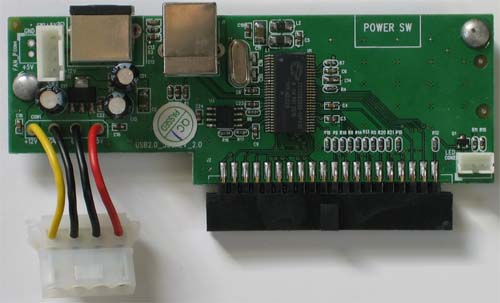
Next up is the Genesis Logic GL811E chipset. This was found in a USB to IDE adapter under the brand Bytecc.
Bad News!
Sadly the power adapter that came with this unit died after a few months of use, and killed one of my hard drives. Luckily the drive was under warranty. The usb to ide device works fine, it's only the power adapter that crapped out. It goes to show the low quality components used in these chipsets. This was purchased on ebay ultra cheap (<$15).


From the Genesis website:


* Complies with Universal Serial Bus specification rev. 2.0. 
* Complies with ATA/ATAPI-6 specification rev 1.0. 
* Complies with USB Storage Class specification ver.1.0. (Bulk only protocol) 
* Operating system supported: Win XP/2000/ME/98/98SE; Mac OS 9.X/X. 
* Integrated USB 2.0 Transceiver Macrocell Interface (UTMI) transceiver and Serial Interface Engine (SIE). 
* Supports 4 endpoints: Control (0)/Bulk Read (1)/Bulk Write (2)/Interrupt (3). 
* 64/512 bytes Data Payload for full/high speed Bulk Endpoint. 
* Supports 16-bit Multiword DMA mode and Ultra DMA mode interface (Ultra 33/66). 
* Embedded RISC CPU. 
* Supports Power Down mode and USB suspend indicator. 
* Supports USB 2.0 TEST mode features. 
* Supports 2 GPIO (GPIO5 & 6) for programmable AP (only for 64 pin package). 
* Supports device power control for power on/off when running suspend mode (only for 64 pin package). 
* Supports 32 bit and 48 bit LBA hard disk. 
* Provides LED indicator for Full Speed and High Speed (only for 64 pin package). 
* 12 MHz external clock to provide better EMI. 
* 3.3V power input; 5V tolerance pad for IDE interface. 
* Supports Wakeup ability. 
* Available in 48-pin LQFP and 64-pin TQFP package. 


Test System
All tests were performed with a Seagate 200gb hard drive model ST3200822A (7200.7)

2.13ghz Pentium M 770 (dothan)
915GM Speedster-FA4
512mb PC2-4300 DDR2
915GM Northbridge
ICH6R Southbridge


Synthetic Benchmarks
HD Tach was used to measure sequential read speed

Burst Average
Genesis GL811E 35.1 34.7
Prolific PL2507 35.0 33.7
Cypress AT2 33.9 32.7
Ali M5621 26.9 26.1
MB/sec

HD tach


"Real World" Benchmarks
Using IOMeter the following sitations were tested:
   100% Random Read speed
   100% Sequential Read speed
   100% Sequential Write speed
   100% Random Write speed
   StorageReview.com File Server Benchmark
   StorageReview.com Web Server Benchmark

The 100% random and sequential tests are included to show the performance in extreme situations. These represent the most ideal (100% sequential) and least ideal (100% random) of overall performance. This is a good way to iron out overall performance of the chipsets, but aren't a TRUE real world performance indicator. These tests represent a "more real world" performance scenario than HDTach.

StorageReview.com is a leading authority in the hard drive bendhmarking community. The benchmarks they created are the BEST real world test I present in this article. The File Server benchmark consists of
All Tests Were Performed on a clean windows xp sp2 installation without any applications running.
First, the Genesis GL811E chipset was tested for 2, 5, and 10 minutes at 100% sequential read with a que depth of 64.
2 5 10 test length in minutes
525.86 535.40 534.33 I/O ops per Second
There are no significant variations in IO/s from 5 to 10 minute test lengths. It was determined that all of the tests would run for 10 minutes for optimal sample size.


Green cells are the best, with yellow 2nd best, orange 3rd best, and red for the worst. Please note that some tests had the same results, so the colors are the same in that case, and may only go up to orange.

ALi m5621 64K write rand 64K write seq 64K read rand 64K read seq que depth ALi m5621 SR Testbed
  80.4 347.9 56.2 403.8 I/O Ops 1 File Server 65.4 I/O Ops
  81.0 348.2 61.1 410.4   4   69.7  
  82.4 348.2 79.7 410.5   16   88.3  
  89.7 348.2 92.4 410.5   64   100.8  
  5.0 21.7 3.5 25.2 MB/sec 1 Web Server 62.4 I/O Ops
  5.1 21.8 3.8 25.7   4   68.7  
  5.2 21.8 5.0 25.7   16   91.8  
  5.6 21.8 5.8 25.7   64   108.2  
         
Cypress EZ-USB AT2L 64K write rand 64K write seq 64K read rand 64K read seq que depth Cypress EZ-USB AT2L SR Testbed
  80.6 420.6 57.7 500.1 I/O Ops 1 File Server 66.4 I/O Ops
  81.7 421.2 62.8 503.1   4   70.2  
  82.4 421.2 82.3 503.1   16   89.2  
  90.0 421.2 95.6 503.1   64   101.9  
  5.0 26.3 3.6 31.3 MB/sec 1 Web Server 62.9 I/O Ops
  5.1 26.3 3.9 31.4   4   68.9  
  5.1 26.3 5.1 31.4   16   92.8  
  5.6 26.3 6.0 31.4   64   108.9  
         
Genesis GL811E 64K write rand 64K write seq 64K read rand 64K read seq que depth Genesis GL811E SR Testbed
  80.2 421.2 57.8 534.2 I/O Ops 1 File Server 67.2 I/O Ops
  81.4 421.6 63.3 540.8   4   71.1  
  82.6 421.6 83.6 541.3   16   90.3  
  89.7 421.6 97.3 541.6   64   103.0  
  5.0 26.3 3.6 33.4 MB/sec 1 Web Server 63.7 I/O Ops
  5.1 26.4 4.0 33.8   4   70.0  
  5.2 26.4 5.2 33.8   16   93.9  
  5.6 26.4 6.1 33.9   64   110.6  
         
Prolific PL-2507C 64K write rand 64K write seq 64K read rand 64K read seq que depth Prolific PL-2507C SR Testbed
  80.4 420.3 58.1 527.8 I/O Ops 1 File Server 66.4 I/O Ops
  81.0 421.1 63.7 531.5   4   71.0  
  82.2 421.1 83.8 531.5   16   90.4  
  89.7 421.0 97.1 531.4   64   102.4  
  5.0 26.3 3.6 33.0 MB/sec 1 Web Server 63.2 I/O Ops
  5.1 26.3 4.0 33.2   4   69.7  
  5.1 26.3 5.2 33.2   16   93.9  
  5.6 26.3 6.1 33.2   64   109.8  


Conclusions And Thoughts

Synthetic Benchmark Clearly the Genesis GL811E is the fastest chipset presented in this review. The Prolific PL-2507C is VERY close behind it in many of the tests. I would consider them almost identical in terms of overall performance. The Cypress chip starts to lag behind with about a 7% decrease in sequential read performance., and the ALi chip has horrible performance with 25% fewer sequential read IO/s than the Genesis chip, and 25% fewer MB/sec in the HDTach test. When copying large files that will be presented in a sequential manner, these the Genesis GL811E and Prolific PL-2507 chipsets will clearly outperform the others.

Real World The StorageReview.com test show a much more even scoreboard. This is most representative of real world performance. With a real world stream of I/O operations there are many combinations of random and sequential data that will help to level the playing field. The largest variation of I/O operations per second among all of thes test was 2.2.

If you're looking for an every day hard drive enclosure to use on a typical day-to-day basis these tests have shown that most enclosures using these chipsets will perform similarly. If you are looking to copy many large files, such as backups backups, you will want to get something with a higher overall sequential read speed, such as the Genesis or Prolific chipsets.
More Benchmarks Are Coming!

Next up!!!:
IPEAK Benchmarks coming!!!
These same tests with the drive on a native IDE connector!!
How do these compare to the NEC 1 or 2 and Myson Century chipsets?
How does this compare to an external SATA pcmcia card in a laptop with an SATA to IDE converter, with this VERY SAME DRIVE!!?!?!


Originally Posted: 11-19-05
Last Revision: 3-17-07

Revision History:
3-21-07 - added potential updates and system specs
3-19-07 - added IOmeter benchmarks and conclusion section
1-14-06 - updated links and styles
12-12-05 - added synthetic HDTach benchmarks

<- Back to 2XOD.com
All Images and Content ©2007 2XOD.com
All Rights Reserved

Comments? Questions?